
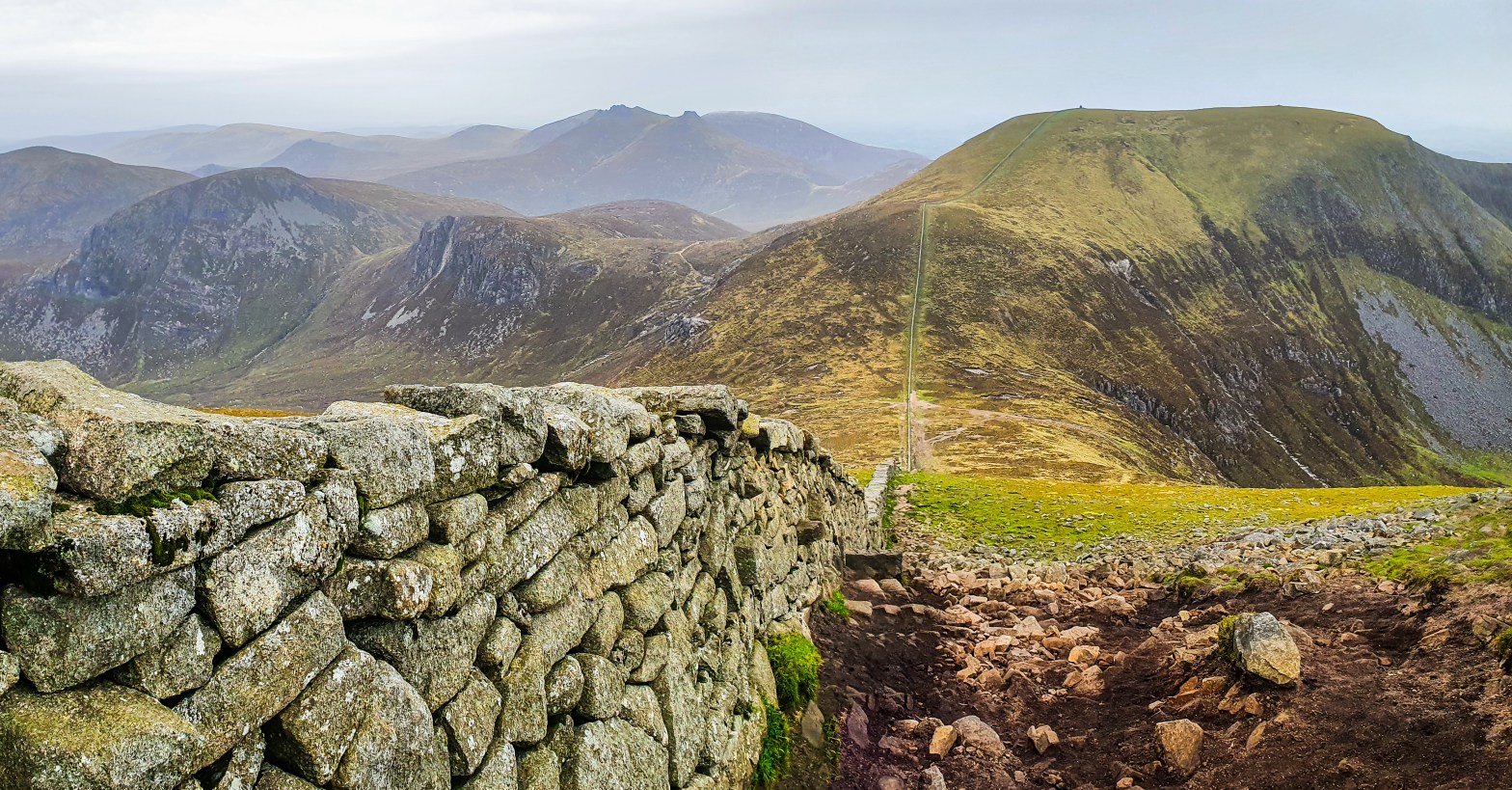
The only thing of importance: putting one foot in front of the other. Focus on the next step. Fully present in the here and now.
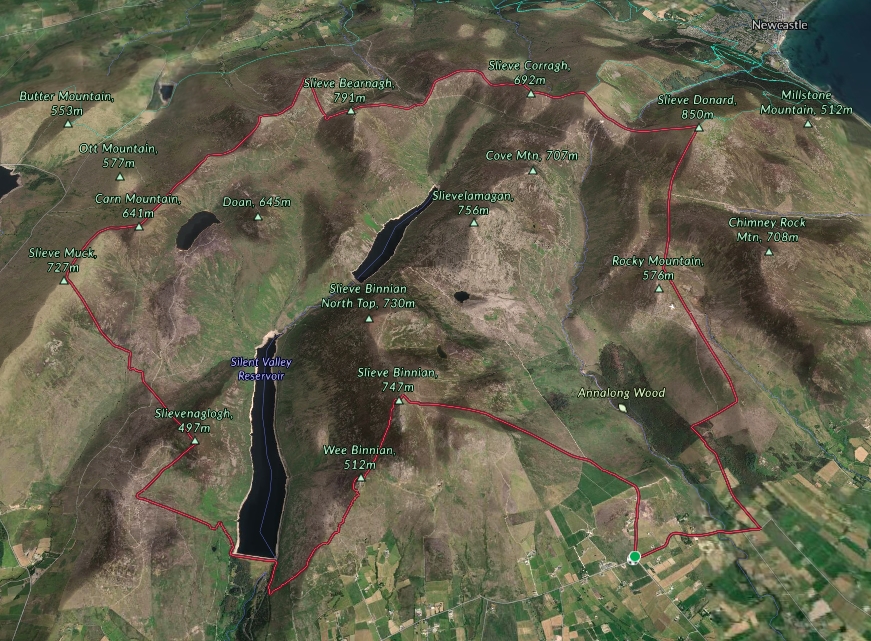
Autumn 2020: This was on the bucket list for a while. Delayed for a variety of reasons, but finally here: I’m standing right beside the Mourne Wall in a bid to complete the ‘Mourne Wall Challenge’: a 30-34km long loop (depending on the exact route taken) that appears simple enough on the surface.
All you have to do is following this one and half metre high stone wall over 15 peaks across the steep and rugged terrain of the Mourne Mountains in the East of Northern Ireland. Easy. Right?
The Wall
A major feat of construction back in the day, built in the early twentieth century with the purpose of enclosing the Silent Valley Reservoir – which is serving Belfast with fresh water – and the aim of keeping the roaming cattle and sheep away from the precious water.
It must have been an exhaustive work getting the stones to build the wall all the way up those steep mountains. Crafted from natural granite stone using traditional dry stone walling techniques, the wall remains – to the most part – in pretty decent condition and can be seen from all over the Mournes.
The Challenge
Standing on the edges of Slieve Binnian, after a 30 minute power hike up the very first steep ascend of many more to come on this loop, the views are breathtaking. Down in the valley I can make out the water reservoir. I’ll need to get there next. Begs the question: how?
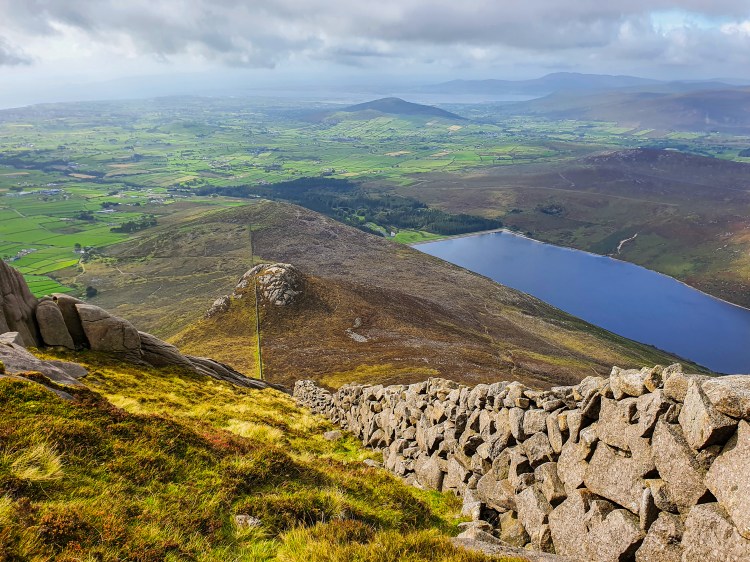
Is there really a safe way down this mountain? The descend appears frighteningly steep: I’m having second thoughts. This can’t be the “official” trail.
Sliding down on my arse on raw granite rock, soon enough boulders turn to wet grass and everything gets a little easier, although it’s still remarkably steep and I make a mental note: one day let’s try to climb up Binnian this way. Not today, though. Happy enough to survived the descent.
Passing Silent Valley, then wading through the bog and pushing up the short but rocky – and dare I say it – brutally steep climb to Slievenaglogh, I’m approaching the infamous Slieve Muck. It’s steep – of course! Which is why the wall breaks in some parts and you have to detour to avoid a near vertical granite wall.
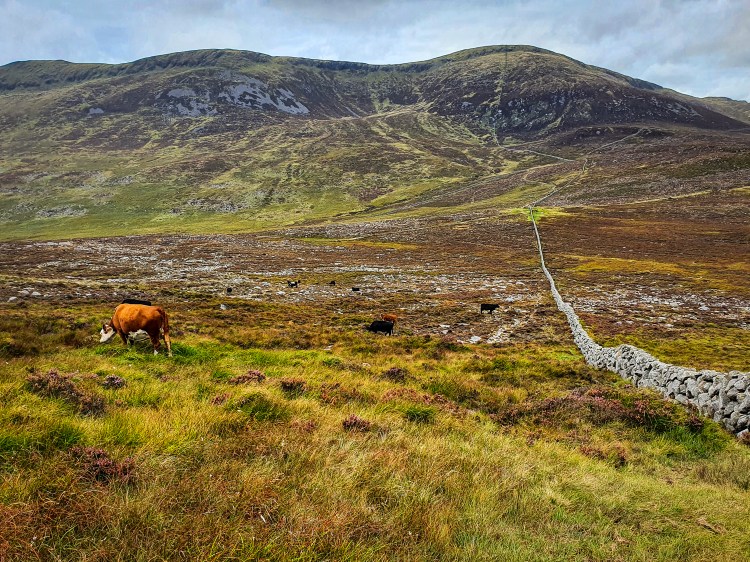
The Muck climb averages 30% over merely 1km, and awaits with 40%+ gradients in its steepest section for a 310m elevation gain.
The hard work is worthwhile. The views from atop the 670m high peak are splendid. On the other hand, as far as the loop goes, this only marks kilometre twelve! Still a long way to go; albeit a lot of the climbing is already out of the way, what’s to come isn’t for the faint-hearted either.
The following five kilometre long stretch to Slieve Meelmore is less spectacular, yet an even more so draining affair: a constant up and down, and looming larger with every passing mile comes Slieve Bearnagh into view. From some angles this mountain appears rediciouslily steep and simply impossible to climb, particularly when dark storm clouds hanging low.
It isn’t nearly as impossible once climbing it, which doesn’t mean the 500 metres averaging a 32% gradient wouldn’t feel like hell, even more so with driving winds and rain pushing from the front!
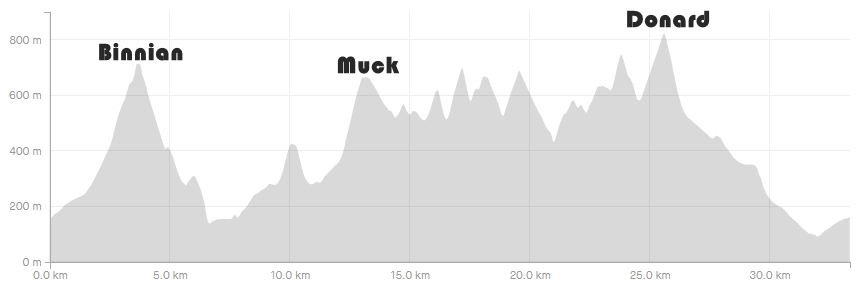
The good: more than half the journey is done at this point. And the final third offers a long downhill, once all hills are successfully negotiated over the next stretch of six kilometres.
The bad: It’s three more steep, brutal and unrelenting climbs – including the highest peak of Northern Ireland, which is fittingly the final one to conquer!
This section is hard. Legs are tired, quads burning, knees hurting, after hours on end of running and power hiking up and down, the ascents to Slievenaglogh (same name, but not the same mountain as the similarly named in the south of the Mournes), Corragh and Commedagh feel all the harder. They aren’t overly long, but steep and energy sapping as they arrive back to back in quick succession.
Personally I found these smaller but extremely steep hills the most difficult to negotiate. The longer climbs, as hard as they are, allow for finding a rhythm. These rolling stretches don’t allow for that luxury. It’s up and down constantly on steep, sometimes technical terrain. You have to focus all the time, for every single step…. until you finally stand at the bottom of Slieve Donnard.
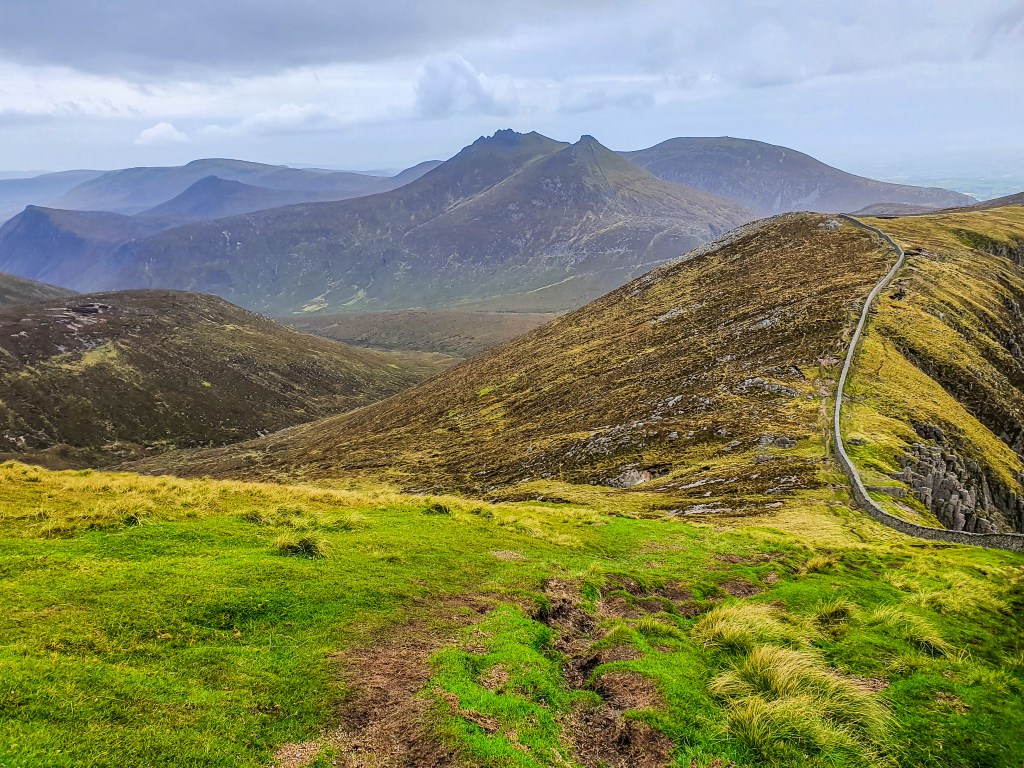
Donnard is the highest mountain in Northern Ireland, towering at 853 metres over Ulster. It’s seems a never ending track to the top.
This is a proper grind. But that suits me. Grinding it out, simply putting one foot in front of the other, settling into an energy preserving slog. One has the luxury of more or less regular stone steps here. Although it’s the final climb after a long day and the highest point of the route with a 32% gradient, Donard feels like the easiest climb of all the major ones.
The home stretch: Practically all downhill, bar the final kilometre on the road back to the car park (rising a paltry 6% on average – feels like 20% at this point in time, though). I run on top of the wall here, to avoid the awful bog.
It took me more than eight hours to complete this first time (even longer, if taking breaks into consideration).
The Race Effort
I had to come back and go all out. Two weeks later it was time for my next attempt. Having mapped out strict time schedule beforehand, the aim was a sub six hours finish. Ambitious yet somewhat within reach, or so was the hope – a stretch goal, given I had quite a few hours to cut on a running clock from a fortnight ago.
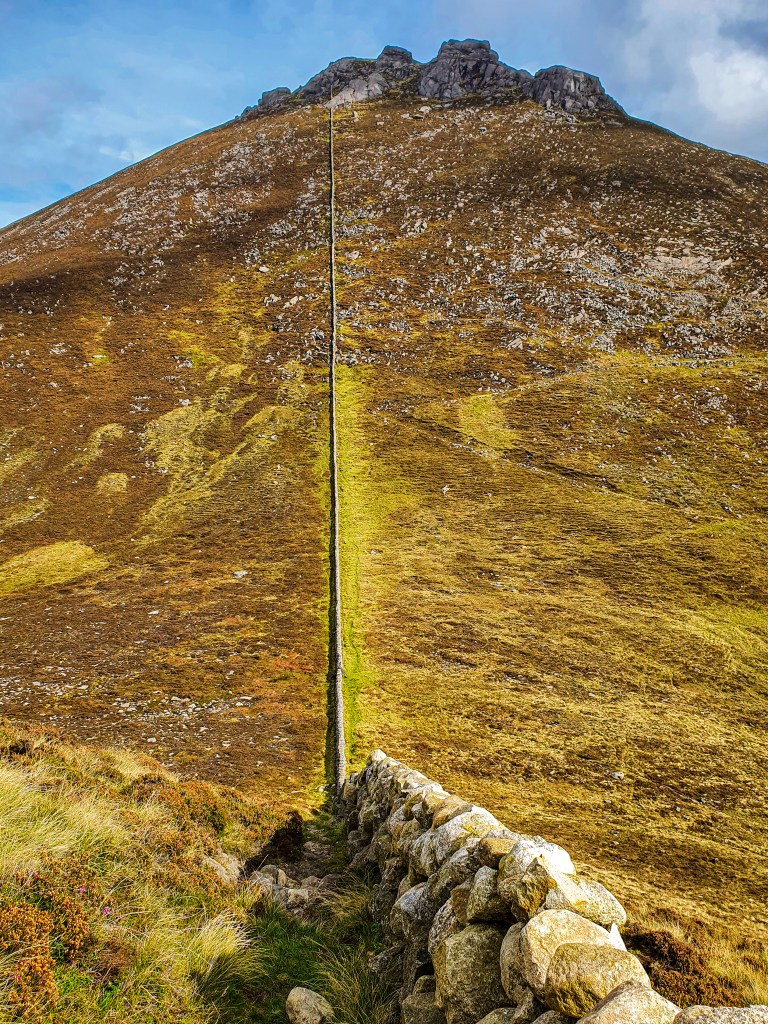
A purposeful yet energy efficient effort takes me to the top of Slieve Binnian in 40 minutes. Knowing my way down this time, I’m ahead of the schedule when arriving at Silent Valley Reservoir, the lowest point of the route.
Life is good after a short but steep and rugged climb up Slievenaglogh. I pass a number of hikers that struggle on the middle section with its leg breaking 40% gradient. 10k in, one third done: it was a blast!
The second of the “key climbs” is next on the agenda and suddenly I feel like going backwards. I hastily munch a “Kinderiegel” for some well needed energy boost. It doesn’t help.
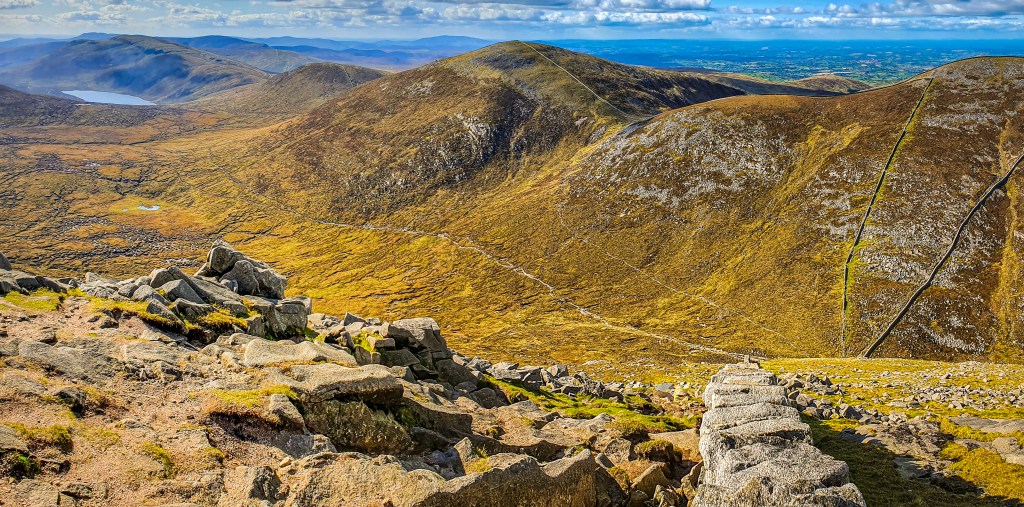
Halfway through the ascent of Slieve Muck nausea sets in, my pace slows dramatically. I hardly make progress. I’m on the limit on every subsequent climb as well -the tank is empty.
Analysis will show afterwards that in this middle section I was hardly faster than two weeks ago, when travelling like a tourist through the landscape, stopping for photos and chatting with fellow hikers. With more than half of the route still to go I am “kaputt”. Sub Six is slipping away. But there is no easy way out here. Keep moving for a few more hours and enjoy the experience, I say to myself.
Thankfully the constant up and downs keep the mind occupied. Also: I am much faster in the final third of the loop this time, recovering from the earlier issues. This, together with the fast start to the day, means I arrive back at the car in 6 hours and 44 minutes – a lot faster than the first attempt. But there is nothing left in the legs as I stop the watch. This is so brutal yet so beautiful all at the same time!
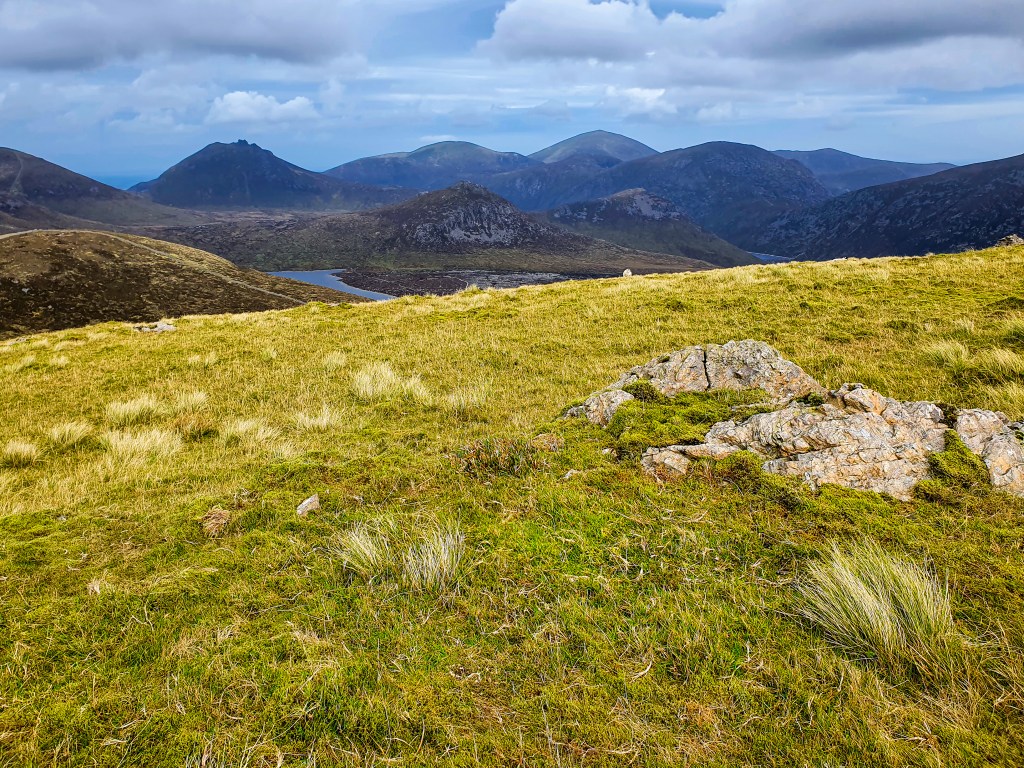
The Mourne Wall Challenge is a highly rewarding route. The views are spectacular. It certainly never gets boring: up and down, up and down…. It’s worth to take the time to admire the landscape. Simply soaking it all in. It’s equally worth if one ones to test their physical (and mental) limits.
But be warned: these mountains are ruthless. There’s no hiding. Only pure muscle strengths in calves, glutes and quads will get you to the top.
The Mournes aren’t particularly high in the grand scheme of things. The climbs aren’t overly long. However, the steepness is something else. It certainly was a shock for my system.
The Wicklow Mountains are wonderful – they are my regular playground – but rather rolling and with few exceptions nowhere near as steep as the Mournes are. I found running the steep climbs impossible and it was power hiking most of the time. Which is a discipline in itself worth working on in training if someone wants to go really fast and hard for a FKT attempt perhaps on this loop.
I for one will be back. Not in two weeks. But maybe in spring 2021 – fate (or pandemic) permitting.
 Uphill Runner