
Whether as a form of cross-training or as a way to stay fit while being injured, swimming offers a variety of benefits for runners.
Want to become a better runner? Run more. It’s that simple, and generally true. In theory. However, in practice, it’s not quite that simple. Yes, ideally we would always run more because it’s the most specific form of training for runners. In reality, though, not everyone can easily increase mileage – for a variety of reasons. And sometimes, when injured, for example, running isn’t an option at all.
Increasing mileage means a higher load for muscles and joints to absorb. That’s not a problem on its own; however: life circumstances, injury history, or – and that’s not to be underestimated – the mental toll of running more, can be valid reasons why increasing mileage isn’t always the best solution.
Mental fatigue can suck the joy out of running and can potentially lead to burnout or overtraining. You have to be a healthy runner to become a better AND happy runner. That requires finding the right balance between mileage, intensity and recovery.
Cross-training plays a vital part in staying a healthy and happy runner. Therefore it’s aiding the process of becoming a better runner.
Any form of cross-training provides a different stimuli for the body. Muscles are used in a different way and different muscle groups become activated as well. This supports the “well-rounded athlete”.
Especially during times of injury, when running isn’t possible for a prolonged period of time, a different form of training is crucial to avoid the loss of fitness, or simply to provide purpose, structure and a continued training stimuli during the rehab phase.
Swimming for Runners – Why?
Whatever the need for cross-training, I’m a huge advocate of swimming as a form of relevant cross-training for runners.
Swimming is often neglected and seen of little value for runners: how can a non-weight bearing exercise, that has nothing in common with running, be any good for runners? Fair question, and one worth exploring a little deeper.
If anything, swimming plays a significant part in active recovery exactly because it’s a non-weight bearing exercise. At the same time – depending on the exact swimming stroke – many different muscle groups (some not regularly used for running at all) are put to work in the pool. A swim can be a varied experience: as easy or as intense as one wants to make it – depending on stroke, pace and duration.
Water’s natural buoyancy counteracts the effects of gravity and thus reduces the pressure on our body’s weight-bearing joints. It alleviates stress on muscles, tendons and ligaments. An easy swim can support muscle recovery as it promotes blood flow, thanks to the simple activity and movement itself – minus the stress and pressure.
As a non-weight bearing exercise swimming is ideal for active recovery on non-running days.
But swimming can be much more than only sparring as an active recovery tool: in fact, swimming can aid aerobic base building, support leg strengths, facilitate improved flexibility as well as body posture, and may even provide the opportunity to train controlled breathing under strain.
The deeper we explore the key benefits of swimming for runners the more it becomes obvious how swimming can benefit the development of the well-rounded athlete. This is crucial, especially for the trail runner: a sport that takes place in the outdoors, where it’s up and down the mountains, intensities shifting constantly, sometimes it’s not even pure running but power hiking, or – in particularly technical terrain – even scrambling.
Let’s not forget that in the human body everything is connected: the mind drives the body as much as strong muscles push us forward. A well-developed core supports the running mechanics and helps to avoid imbalances. Relaxed breathing allows the mind to focus in the moment. Swimming can teach the runner valuable lessons in this regard.
1) Control Your Breathing:
Oxygen is needed for the muscles to function properly. While oxygen is constantly available on land, it comes at a premium in the water: here the head is submerged under water; breathing is only ever possible with the next stroke when the head lifts out of the water.
Therefore, a defining key element to swimming is the need of controlled, efficient breathing, while staying relaxed when not having the option to breath (depending on the individual stroke). A swimmer has to force the body to work with the oxygen available at the given moment – even at the highest intensity, breathing has to be calm and controlled in line with the swimming motion.
To be precise, it’s the response to the build-up of CO2, rather than a lack of oxygen (O2), that forces the urge to breath. And it’s especially the rapid build-up of CO2 during an intense effort, that induces significant discomfort and may force us to slow down – that’s thee same in swimming as it is in running.
Rapid build-up of CO2 in the body tissue during intense efforts has a detrimental effect on performance. Good news: CO2 tolerance is highly trainable.
No matter the activity, tolerance to CO2 indicates how well an individuals body can utilize oxygen to fuel cells, i.e. O2 efficiency is directly linked to CO2 tolerance. That’s the reason why CO2 tolerance is an element relevant for runners as it is for swimmers.
The good news: CO2 tolerance is highly trainable and positive adaptations achieved fairly quickly. The pool is one of the best ways to train CO2 tolerance: as discussed earlier, swimming is kind on the body, while breathing – or the lack of it – is such an essential part of swimming.
Individual levels of swimming ability vary, though with regular practice anyone can learn to stay relaxed under water when oxygen isn’t readily available. Taking quick, efficient breaths that deliver enough oxygen in the shortest amount of time becomes an automatic habit. The result is a learning effect that will make diaphragmatic breathing more natural with clear benefits for runners.
For example, when running hard, perhaps at the end of a threshold workout or a race, breathing can be all over the place. Often these high intensity efforts force runners to take short and shallow breaths. This heavy in/exhaling in rapid succession isn’t the ideal way of delivering oxygen to the body when most in need, though.
It has been proven that diaphragmatic breathing (aka deep belly breathing) is the most efficient way for maximal oxygen uptake (VO2 max), rather than the shallow chest breathing described above – even during high intensity exercise. That’s easier said that done under pressure: relaxed, controlled (likely slower than what feels right) breathing doesn’t come natural and is a skill that needs to be learned.
This is exactly what’s trained in the water: because it’s the non-negotiable part in swimming. The learning effect, once fully familiar and comfortable with it, will transfer to land as well: controlled breathing will become easier when running, so more oxygen can be used more efficiently and thus can lead to improved performance.
2) Train CO2 Tolerance:
This is a proven fact: a study of the Scandinavian Journal of Medicine in Science showed that after only 12 sessions of swimming with controlled breathing, 18 individual athletes showed a 6% increase in running economy – a significant increase in a relatively short space of time.
Consequently: simply getting into the pool and start swimming will be beneficial to runners, especially on the aspect of recovery. In order to unlock additional benefits – such as greater lung capacity, teaching the body to work with all the oxygen available during a workout and increased CO2 tolerance – we need to incorporate specific forms of training into swimming sessions.
To follow on from the mentioned study, when looking into forms of “controlled-frequency breath swimming”, the universal term “Hypoxic training” is often used to describe it. In truth there are two forms of breath-hold training (anything to do with controlling breath is a form of breath-holding): hypoxic- and hypercapnic training.
Elevated levels of CO2 in the body tissue drive the urge to breathe as opposed to low levels of oxygen.
Hypoxic literally means “little oxygen” – i.e. we’re working with a depleted level of oxygen in our muscles. Hypercapnia means “high levels of CO2”. Crucial to understand is that hypoxia (i.e. dangerous low levels of oxygen in the body tissue) will set in much later than the build-up of CO2 will force us to breathe during any form of breath-holding. That’s due to a general lack of tolerance to elevated levels of CO2 in our body tissue.
Try it out: hold your breath… sooner rather than later you’ll feel the unbearable desire to breathe. The reason for this urge (air hunger) doesn’t occur due to dangerously low levels of oxygen – far from it, in fact. Actually, it’s the increased amounts of CO2 building up and the body simply wanting to get rid of it.
What has that to do with running? Everything! We already have established that controlled-frequency breath swimming improves running performance and that our individual CO2 tolerance is a key to unlocking these improvements, given CO2 is one of the major by-products of energy production in the body. Hence, as a next step it’s important to establish the right forms of training in the pool to maximise any possible improvements.
Good news again: we don’t require any long, mentally taxing breath-holds that deplete our oxygen stores and would only make us feel tired the next day. Instead we can focus on shorter, highly efficient workouts that help to induce the desired stimuli.
For breath-holding in generally that translates to the following: short holds & short recovery. While you can absolutely do this on land (in the form of apnea walks, for example), it’s far more enjoyable in the pool and has all the additional benefits we discussed at the very beginning of this piece.
Translating this into actual swimming is easy and incredibly adaptable to the level of swimmer as well the individual familiarity with breath-holding.
Let’s assume someone is a competent swimmer – in a sense they can swim a bunch of laps freestyle – to the point where the actual swimming in itself isn’t an inhibitor:
You can simply start by progressively restricting the number of breaths taken per lengths. For example: breathing every three, five, or even seven strokes. This is a progression exercise that can be adapted to the level of swimmer and individual fitness. It teaches all components of controlled breathing and CO2 tolerance.
Believe me: if you do fast 50 or 100m reps, breathing every 4th to 6th stroke – what feels easy in the first half of the rep, will become gradually more difficult in the second half especially as you progress through the set… and rapidly! Because the build-up of CO2 is rapid as well.
The key is to stay relaxed, focused on taking quick, efficient breaths, engaging the belly for deep breaths when the time comes. And be assured – even if it feels different – you’re not running out of oxygen; it’s only a gas building up in your body (CO2) that gives you the strong urge to breathe – by breathing ever so often, the body is still sufficiently oxygenated – don’t worry about that; O2 levels are back to near 100% after each breath, in fact.
You can keep it as simple as that. Anyone who wants to go a bit deeper, I highly recommend reading Natalia Molchanova’s Methods of Freediver Training. While this is aimed at improving Dynamic Apnea performance, the prescribed workouts are swimming based and highly relevant to the adaptations we want to gain from our own workouts in the pool.
3) Stronger Legs:
All runners can do with stronger legs. To improve leg strengths swimming can be a useful alternative in order to break the general routine of hill sprints or strengths exercises in the gym.
The good thing: in the pool there’s no need to apply maximum force to lift or push, given its a non-weight bearing exercise, hence strengths can be built with a minimised injury risk. This may sound like a contradiction – but it isn’t.
Without using the legs in the water swimming would become a struggle. The kicking motion in freestyle is a key part, either for propulsion or for balance and rotation. Breaststroke or butterfly require good, powerful use of the legs (unless swimming with a pullboy) as well.
Legs can be easily isolated in the pool thanks to the use of a board which leaves all power to come from the lower body in order to create propulsion. Perhaps an even better option is the use of small fins. They are a great tool to swim faster in general, but their use comes at a cost: increased drag and water resistance.
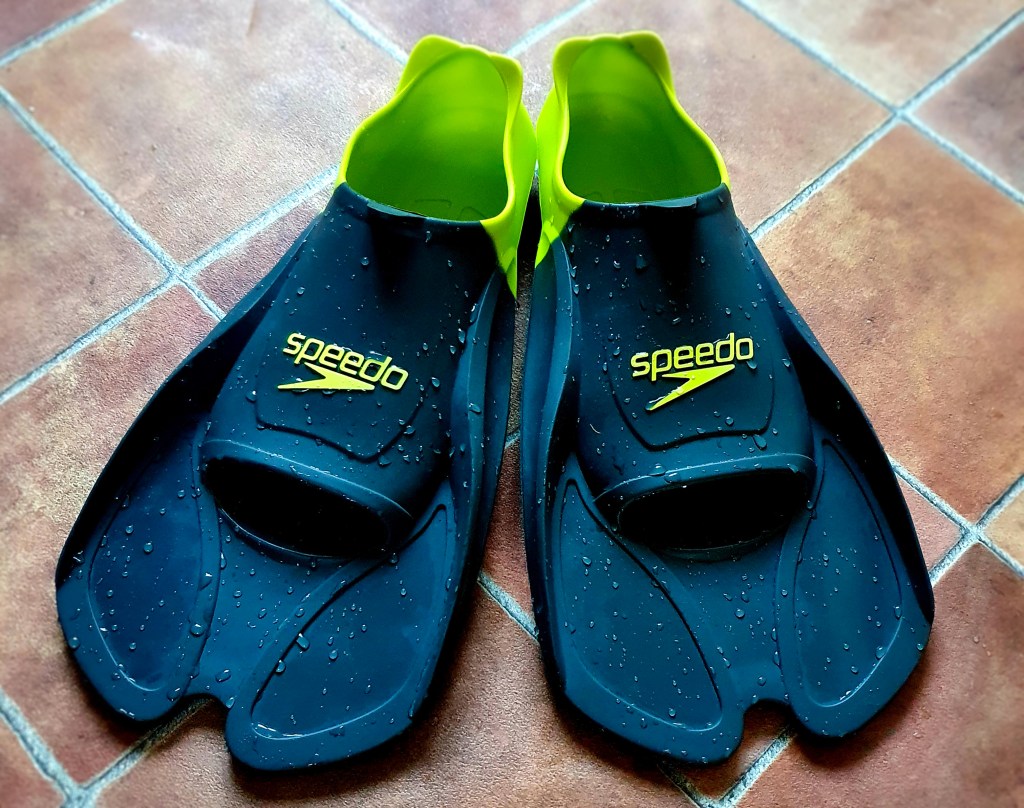
Some fins are specifically designed to create extra water resistance. They make the legs work even harder – a superb tool to build additional strengths as well as ankle flexibility.
Increased water resistance results in more energy required to move forward, but also activates muscle strengths, especially in the calves, hamstrings and glutes. Specific workouts that focus on a powerful kick with fins will provide a solid strengths training for those muscles.
Even without the use of fins, simple flutter-kicking will help with ankle flexibility – something runners often struggle with, even though it’s of significant importance when running on trails and in the hills, due to the constantly changing nature of underfoot conditions.
4) Improve Aerobic Capacity:
We have established the fact that swimming is a low-impact exercise that causes little biomechanical stress on the body. Despite being weightless in the water – which allows bones and ligaments to rest – swimming is a full-body exercise, meaning upper and lower body muscles (arms, core, legs) are engaged during a swim.
With that in mind, it’s clear that heart and lungs have to work hard to pump blood to all those areas – a high number of muscles use energy and significant physiological stress is caused while swimming. Put simply: heart and lungs wouldn’t know (and don’t care) whether we’re running or swimming. Hence swimming can be used as a means of cross-training and will improve cardio fitness.
Not dissimilar to running, familiar training principles can be applied in the pool – granted one is reasonably fit to swim (swim fitness needs to be build up first – even a fit runner may struggle in the pool if unused to the demands of swimming). Both anaerobic and aerobic energy system can be worked, depending on the desired stimulus.
For the cardiovascular system it doesn’t make a difference whether you run, swim or cycle.
Aerobic base can be trained through long, continues swims at a comfortable pace. The better swimmer wants to go up a notch or two and swim closer to their current threshold pace (for example 1:45/100m). Higher-intensity intervals like fast 100 meter repeats (perhaps even 200 meter for the strong swimmer) with only a short rest in between each repeat will help to improve the threshold. These fast and intense sets illicit a significant heart rate spike, in the same way sharp intervals on the road or track do too.
From my own experience, I remember the time of battling a long injury: running was impossible. So I swam. And swam a lot. And it helped a lot!
Once back running I noticed how little base (running-relevant) fitness was lost. Basically the aerobic base was intact as ever, giving me the opportunity to get right into faster training without the need for a long base-building phase. Because the base was already built – or at the very least maintained – in the pool.
Cardio is cardio for the body. It doesn’t matter whether it’s running, swimming or cycling – the aerobic system can be trained effectively either way.
Of course, for a runner there is nothing more relevant and specific to getting better than running. That’s out of question. However, as demonstrated in this article, swimming can be a fantastic way of maintaining and even building fitness or strengths, especially when running more isn’t possible nor desired. It’s an effective way to cross-train that exists in the toolbox of every runner, ready to be incorporated to improve aerobic capacity without adding any significant stress on the body.
5) Favourite Workout – Hypercapnic Intervals:
Goal is the adaptation of the body to be working with a reduced level of oxygen, higher levels of CO2 and therefore to create better “economy” in the water as much as on land when running. A secondary benefit is to learn how to breathe controlled and relaxed under strain.
Intervals should be short – about 50m to 100m. Breathing will be allowed every 4th, 6th, 8th or 10th stroke, depending on the swimmers capacity. Recovery between intervals should be kept short because we don’t want CO2 levels to adjust to normal. They should be long enough, though, to ensure the completion of the next interval is achievable (within the set breathing pattern).
Start off at an easy pace – this is about the breathing pattern, not so much about speed. The intervals can be bumped up to harder and longer efforts as one gets accustomed to it, but the pace should never be so hard as to create failure of completing the next interval in the set (say 10x 50m).
Make sure to exhale fully before taking your breath. Focus on taking quick, relaxed breaths, try to breath actively with the belly for diaphragmic breathing as well. Stay relaxed and composed – as much as possible – while submerged, focus on the next stroke, even if the urge to breath starts to increase.
Depending on your level, the second half of the interval may feel intense. If it’s too intense, and you struggle to get to the end within the assigned breathing pattern, you should reduce the interval distance.
This is a progression exercise. Improvement over time will be easily identified if progression is achieved, i.e. higher number of reps, shorter recovery times, longer intervals. Consistency is key and gains may be realized quickly at the beginning.
Example workout:
A simple workout, that can be easily adapted if it feels too difficult or easy, could look like this (mind: ensure the pace allows completion of the entire workout, it should be hard but achievable towards the end):
- 400min easy warm-up swim (alternate strokes to warm up all muscles)
- 2x 10x50m with breathing every 6th stroke
- 30sec rest between intervals; 2min rest between sets
Word of caution: even if hypoxic- and hypercapnic training isn’t dangerous per se, wherever breath-holding is involved, especially in the water, precautions need to be taken!
Short workouts with restrictive breathing, as suggested above, are highly unlikely to cause blackouts. There’s is simply not enough time for sufficient CO2 to build up. The urge to breathe will be way too intense and forces you to stop or take an additional breath, unless you have solid freediving experience.
However, every body reacts differently to higher levels of CO2, hence it’s still advisable if doing any breath-holding in general, especially longer and more intense workouts, to have a buddy alongside or someone to keep an eye on you. Better be safe than sorry.

